We are pleased to announce Antelope 6.0 Update 1. With Antelope 6, BRTT is moving to a faster release cadence: new capabilities now ship as numbered Updates between major releases, so sites running Antelope 6 should expect substantive additions, not just fixes, more than once a year.
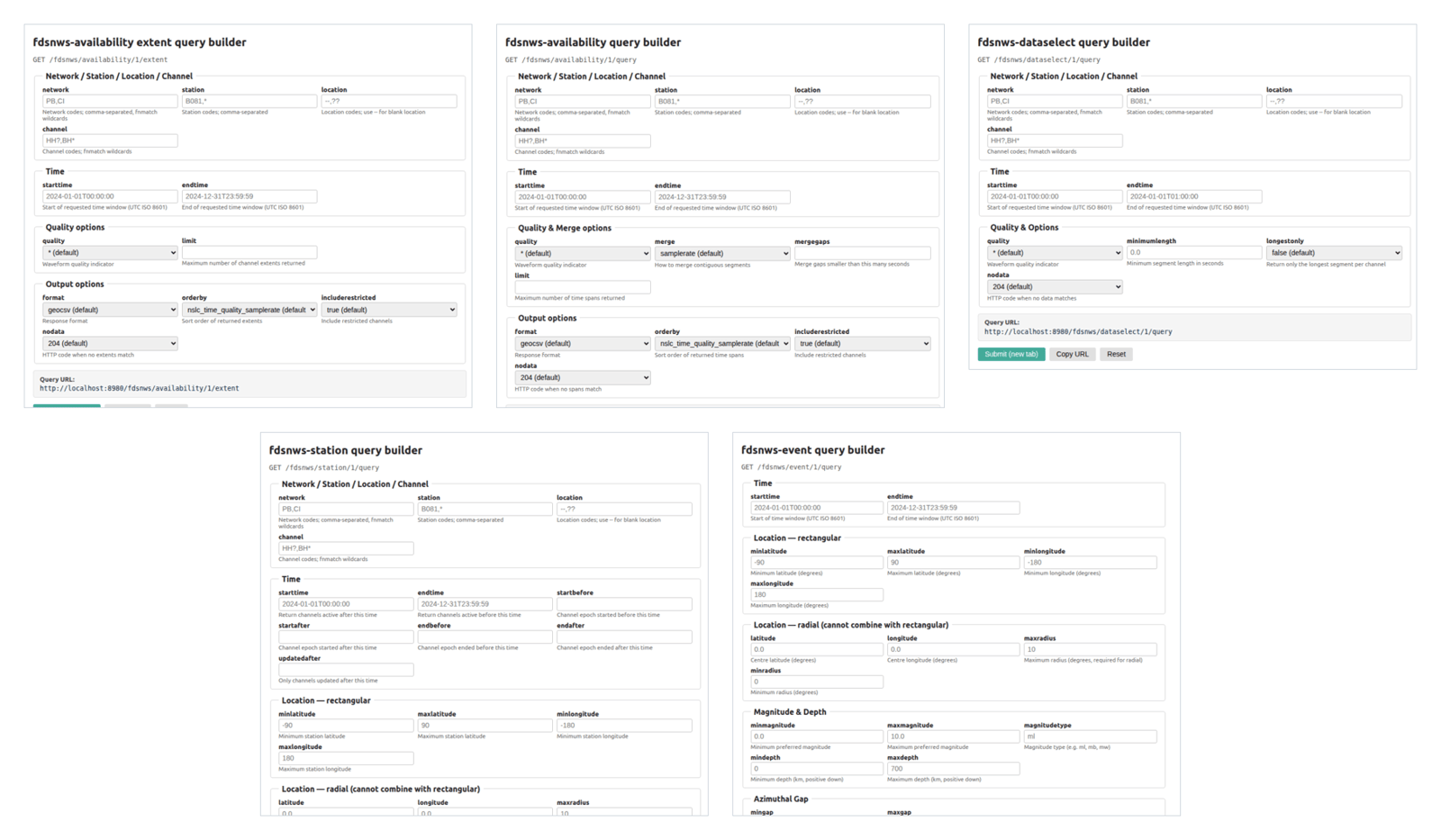
Update 1 opens Antelope archives to the broader FDSN ecosystem, adds full QuakeML round-trip translation, and continues the TCL/Tk to Python/Qt modernization with two more headline tools. If you have been running Antelope 6.0 since its April release, Update 1 picks up directly where 6.0 left off. Here is a summary of what shipped, with a closer look at a few changes worth knowing about.
Headline Additions
- FDSN Web Services Server. A brand-new standalone HTTP server publishes seismic data from a Datascope database over the FDSN Web Services standard, allowing any FDSN-compatible client (ObsPy, IRIS URL Builder, fdsnws_fetch, web mapping tools) to query an Antelope archive directly.
- QuakeML round-trip. The new db2quakeml and quakeml2db programs provide full round-trip translation between Datascope event tables and the QuakeML 1.2 BED standard, the FDSN-recommended interchange format for earthquake catalogs.
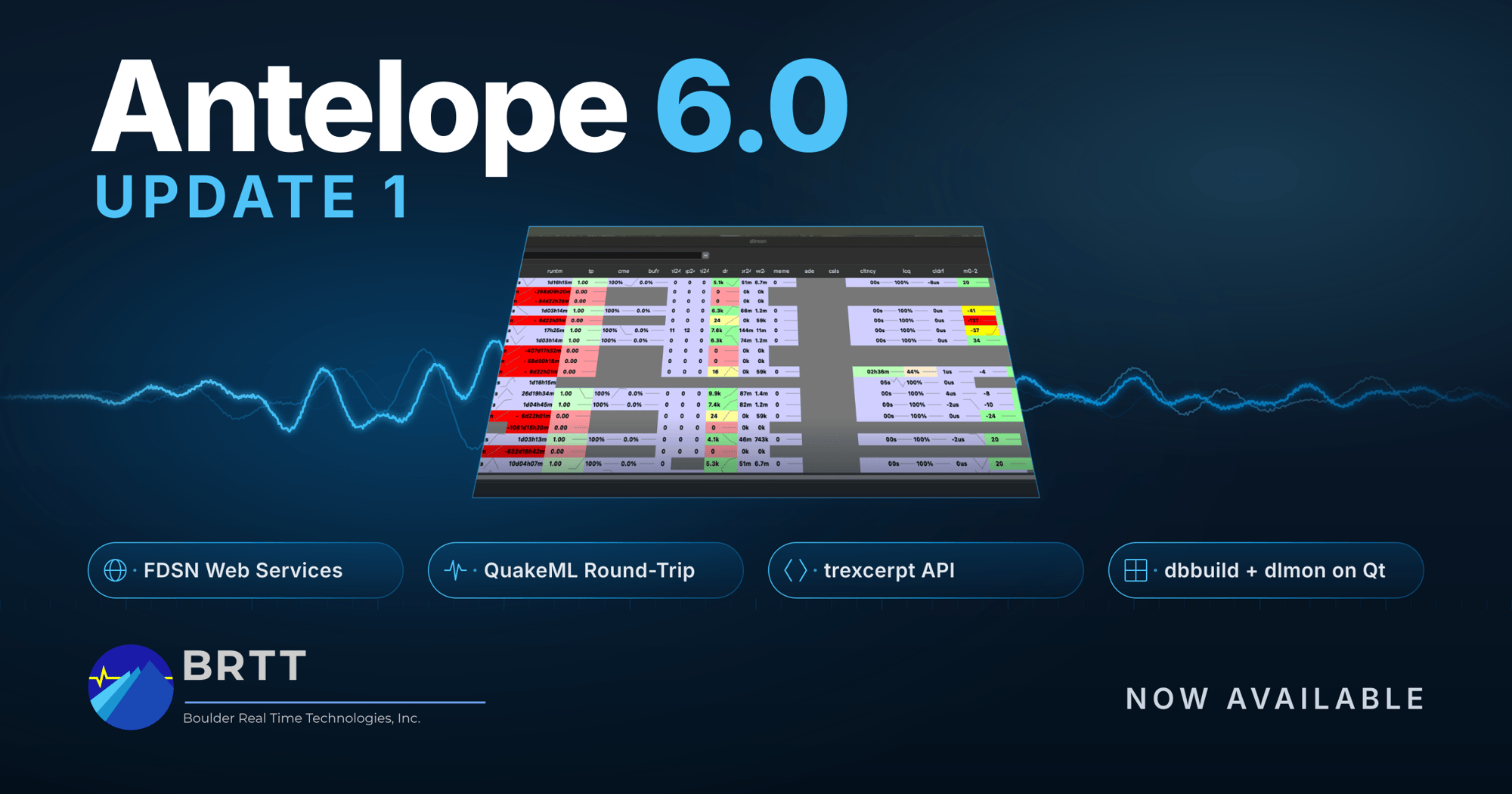
- dlmon and dbbuild Qt ports. Two more cornerstone GUIs move from Perl/Tk to Python/Qt, continuing the user-facing modernization that began in Antelope 6.0.
- trexcerpt C and Python API. The waveform-extraction logic that powers trexcerpt is now available as a reusable C library with Python bindings, enabling programmatic waveform extraction from Python scripts and notebooks without shelling out to the command-line tool.
FDSN Web Services Server
The new FDSN Server implements all five FDSN services via a RESTful API with flexible query parameters and multiple output formats:
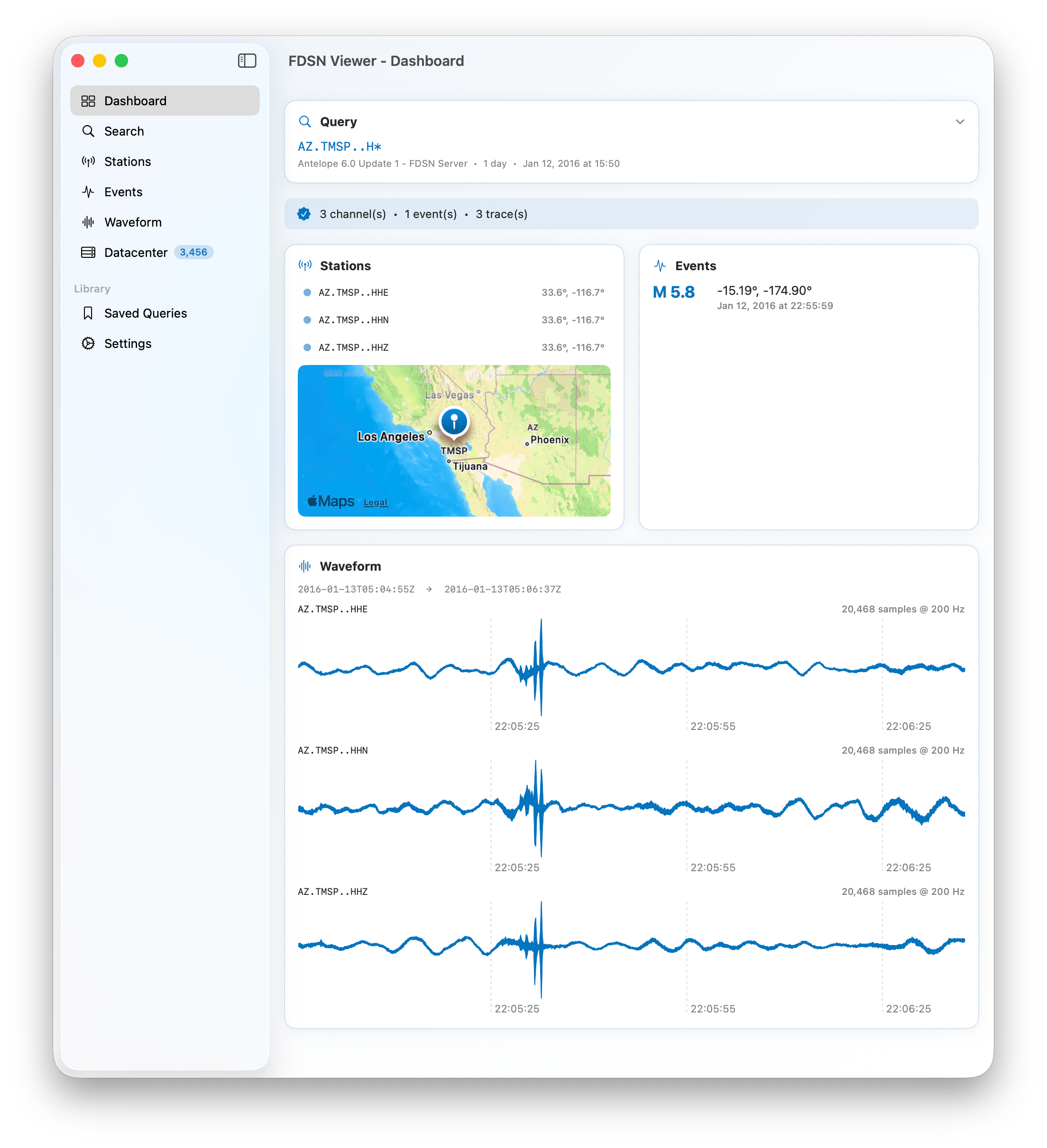
- fdsnws-event. Earthquake catalog queries with filtering by time, magnitude, depth, geographic box or radius, event type, and azimuthal gap. Output as QuakeML, plain text, CSV, GeoJSON, or KML.
- fdsnws-station. Station metadata queries at network, station, channel, or full-response detail. Output as StationXML, plain text, or GeoCSV. An optional includeavailability annotation honors the request's time window so coverage extents reflect the queried interval, and an optional matchtimeseries filter restricts results to channels with actual waveform data in the requested window.
- fdsnws-dataselect. miniSEED waveform delivery with multi-channel POST requests and optional segment-length filtering.
- fdsnws-availability. Per-channel waveform coverage reports (continuous segments or full extent) in text, JSON, or GeoCSV.
- fdsnws-routing. Federated routing responses for multi-node deployments.
Access control is optional and supports three authentication schemes: JWT Bearer tokens, EIDA PGP-signed tokens, and HTTP Basic, with per-channel restrictions configured via NSLC patterns. The server is browser-friendly out of the box, with CORS headers on every response and a built-in interactive HTML query builder for each service. Operations features include live configuration reload without restarting, an optional JSON Lines access log, and an optional Prometheus metrics endpoint for monitoring.
db2quakeml and quakeml2db
The new db2quakeml and quakeml2db programs translate between Datascope event tables and QuakeML 1.2 BED, with full coverage of events, origins (with uncertainty), network and station magnitudes, picks, arrivals, and focal mechanisms and moment tensors. Both CSS 3.0 and CSS 3.1 schemas are supported on import and export.
db2quakeml exports flexibly: preferred-origin-only, preferred-magnitude-only, suppression of picks or station magnitudes, and arbitrary Datascope subset expressions for selecting specific events.
quakeml2db imports are idempotent, so repeated runs of the same input safely skip already-imported records, and the output database is created automatically if needed. SEED network and location codes are preserved on round-trip when snetsta and schanloc mapping tables are populated, and the CSS etype to QuakeML EventType vocabulary mapping is fully configurable via parameter file.
Under the hood, both tools are backed by a new C++ library, libquakeml, with Python bindings. The same library is reused by the FDSN Server.
dlmon Qt Port
dlmon has been ported from Perl/Tk to Python/Qt with the familiar Icons, Multi, and Single view modes, sort and subset behavior, and command-ORB workflow intact. Two visible enhancements are worth calling out.
- Per-field sparklines render on every numeric Multi/Single cell, tracing the most recent 10 minutes of values for that field at-a-glance with no operator clicks.
- The per-cell time-history plot has been revived. A right-click "Show history…" dialog opens a forensic, on-demand time-history view for any individual datalogger field, with selectable look-back windows (1 h, 6 h, 24 h, 7 d, or full ORB retention).
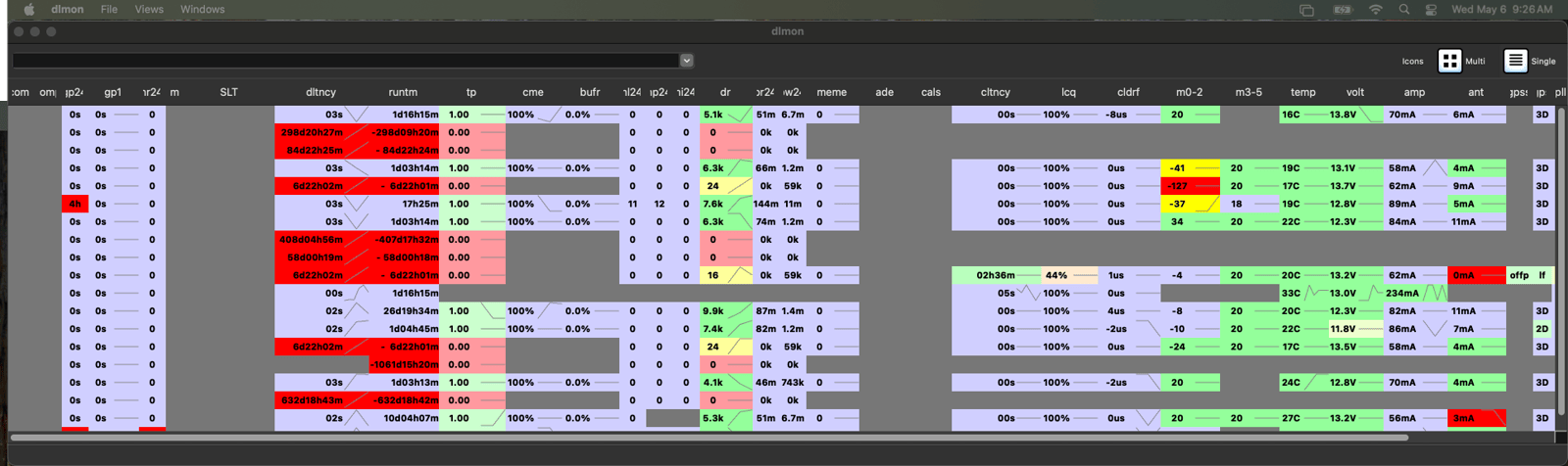
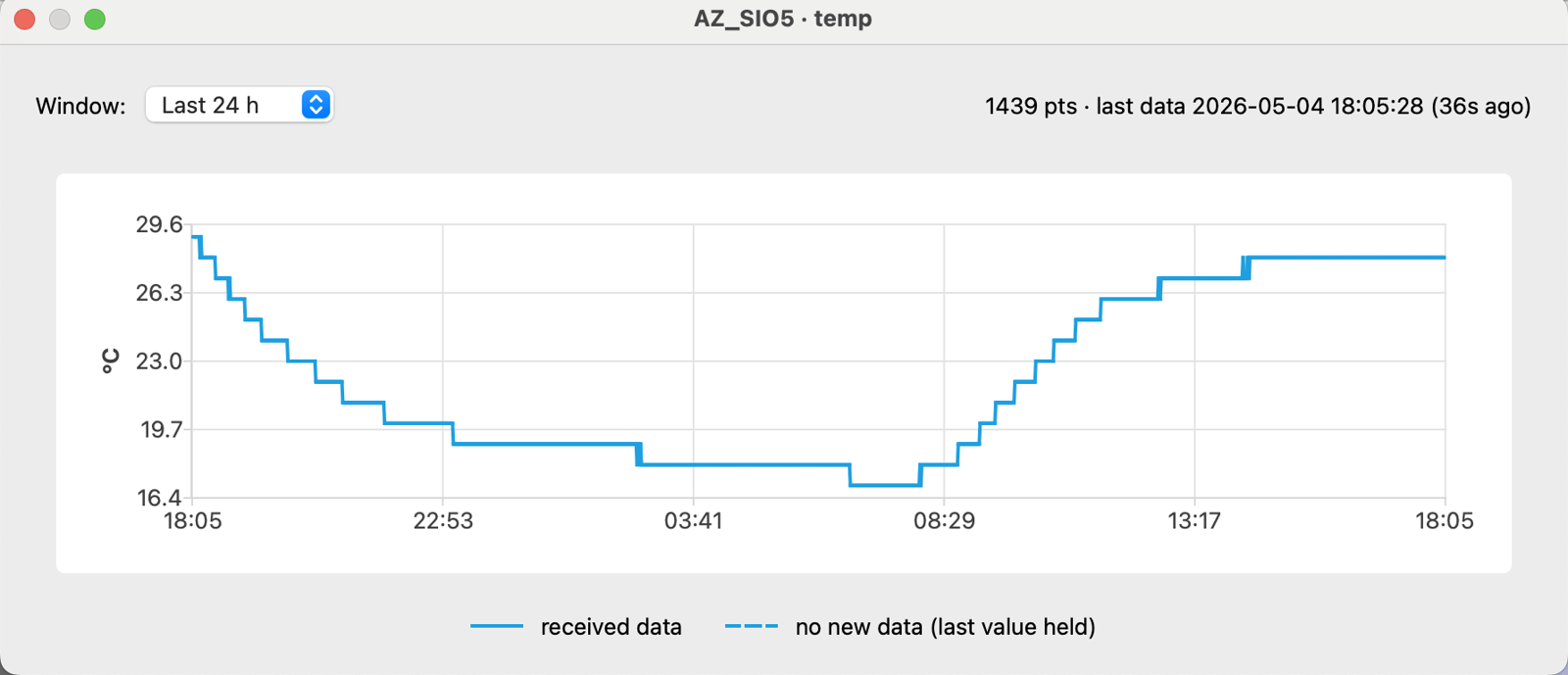
Parameter-file setup has also been simplified. The shipped dlmon.pf is metadata-only, covering fields, view layouts, column titles, sizes, and sort orders. Sites that do not need customizations can deploy dlmon with the shipped .pf as-is, and customizing a field is a small additive edit that overrides only that field's behavior.
The original Perl/Tk implementation is preserved as dlmon_dep (deprecated) for sites that need to fall back during the transition.
dbbuild Qt Port
dbbuild has been ported from Perl/Tk to Python/Qt. The user-facing workflow and feature set are unchanged. This is a 1:1 conversion with a modernized look and feel, and existing users will recognize the tool immediately.
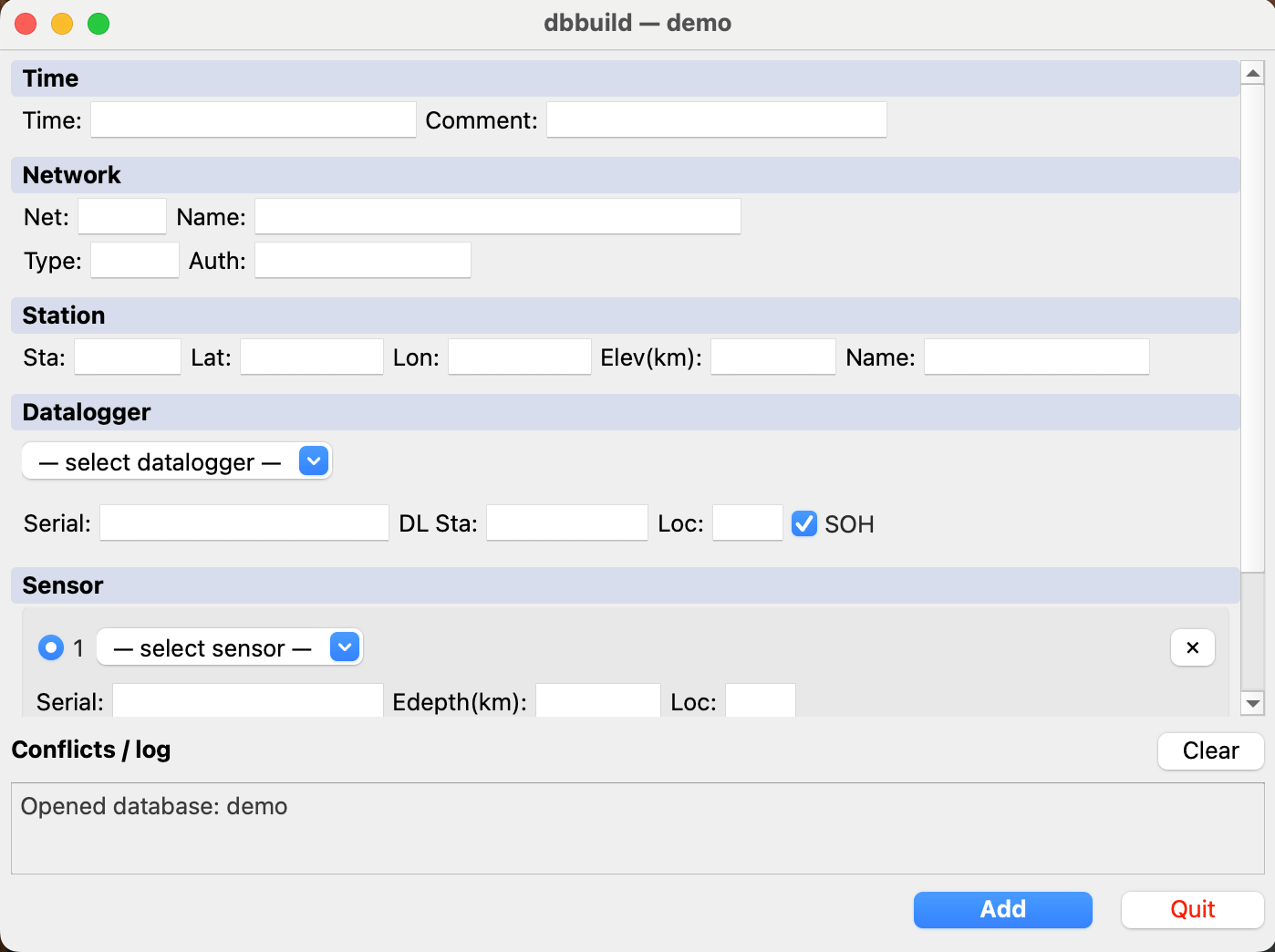
The original Perl/Tk implementation is preserved as dbbuild_dep (deprecated) for sites that need to fall back during the transition.
trexcerpt as a Library
The waveform-extraction logic that powers trexcerpt is now packaged as a reusable C library with Python bindings. All five trexcerpt operating modes (time, event, arrival, convert, and explicit) are accessible from the Python API, opening up programmatic waveform extraction inside scripts and notebooks. The trexcerpt command-line tool is unchanged from the user's perspective; it now runs on top of the new library. The library is already in production as the waveform-delivery backend for the FDSN Server's fdsnws-dataselect service.
db2stationxml
db2stationxml sees a major performance improvement, especially noticeable when requesting network- or station-level output rather than full channel or response detail. There is a further speedup for sites with large stage tables. The CLI has been revised to use standard Datascope filtering.
q82orb
q82orb gains optional subcode tagging for Q8 datalogger streams, bringing it to parity with the long-standing q3302orb subcode mechanism for Q330. When enabled, MGENC packets are published as net_sta/MGENC/<subcode> instead of the undifferentiated net_sta/MGENC stream.
Subcodes distinguish state-of-health (MST, 0.1 sps), clock quality (MLC), GPS and timing (MGPS), engineering data (MEG), 1 sps waveform (M1), and higher-rate waveform packets by sample rate (M40, M100, M1000, and so on). Downstream ORB consumers (archivers, real-time pipelines, monitoring, and visualization tools) can now filter, route, or apply per-group retention policies on Q8 streams using the same source-name conventions already used for Q330.
Get Antelope 6 Update 1
Antelope 6 Update 1 is available now. Existing license holders with an installed Antelope 6.0 instance can run the antelope_update program to install, which will provide the new features (along with a few minor fixes). For users freshly installing Antelope 6.0 from here on out, Update 1 will be automatically applied during the standard installation process.
For questions, email info@brtt.com or visit brtt.com. Current customers can request support by emailing support@brtt.com.