We are pleased to announce the release of Antelope 6.0. Part of our BRTT 3.0 initiative, this is our biggest release in years and represents a generational step forward across the platform. Antelope 6.0 brings significant new capabilities, modernizes the user-facing toolchain, and lays the foundation for the Antelope Cloud Platform.
If you have been following along since our Antelope 6 Preview, several of the headline features will be familiar. Here is a summary of what shipped, along with a closer look at a few changes worth knowing about.
Headline Additions
- Bidirectional SeedLink interoperability. New commercial-grade, multithreaded orb2seedlink and seedlink2orb utilities give Antelope complete bridge capability with the broader SeedLink ecosystem, including miniSEED v3 with GENC packets.
- Native Kinemetrics Q8 support. The new q82orb and q8pocd programs deliver first-class waveform acquisition, state-of-health monitoring, and command-and-control for the Q8 datalogger. q82orb enables dlcmd based control over Q8s in the field, similar to q3302orb.
- StationXML round-trip. The new stationxml2db program ingests FDSN StationXML directly into Datascope databases and has been tested against more than 800 real-world StationXML files. The companion db2stationxml has been extended to support more StationXML features.
- Cloud licensing. A new ID and secret-key licensing method is now implemented throughout the system, powering all of our new lightweight Docker containers. This is all in support of our upcoming Antelope Cloud Platform for Seismology as a Service.
Modernized GUI Programs
A theme that runs through Antelope 6.0 is a generational refresh of the user-facing tools. We are moving away from TCL/Tk and toward Python applications built on the Qt toolkit. This release ports rtm, dbcentral, dbhelp, ecrontab, and showtext to Python and PySide6, with substantial functional upgrades along the way. All of these are complete rewrites.
rtm
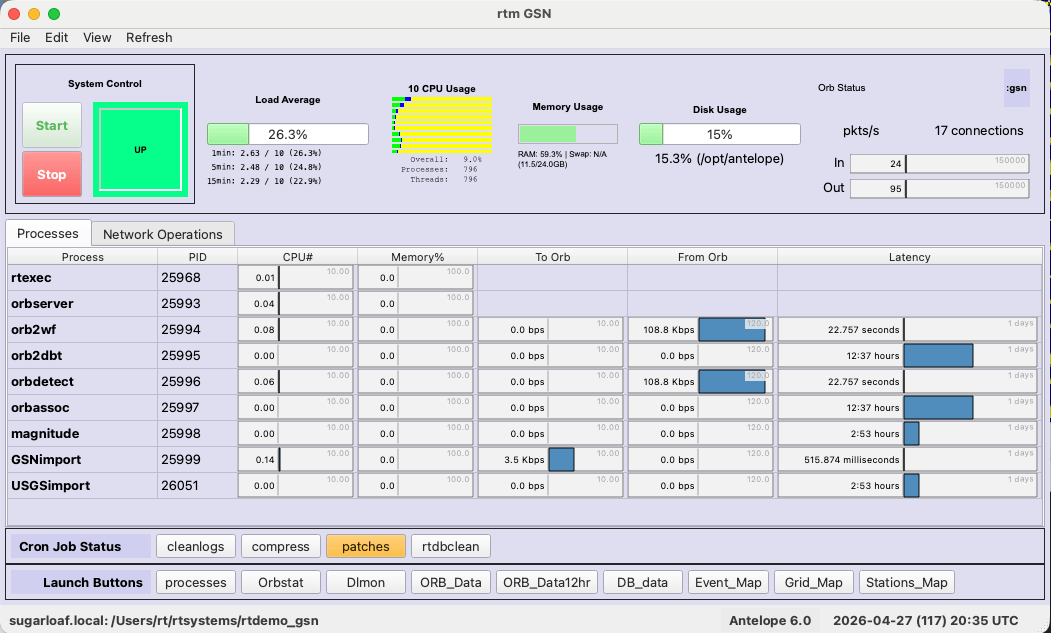
rtm picks up much more accurate memory and CPU usage tracking and display, a cron-job status bar, configurable row height, better menu and icon handling, and preserved window position across stop/restart cycles.
orbstat_gui
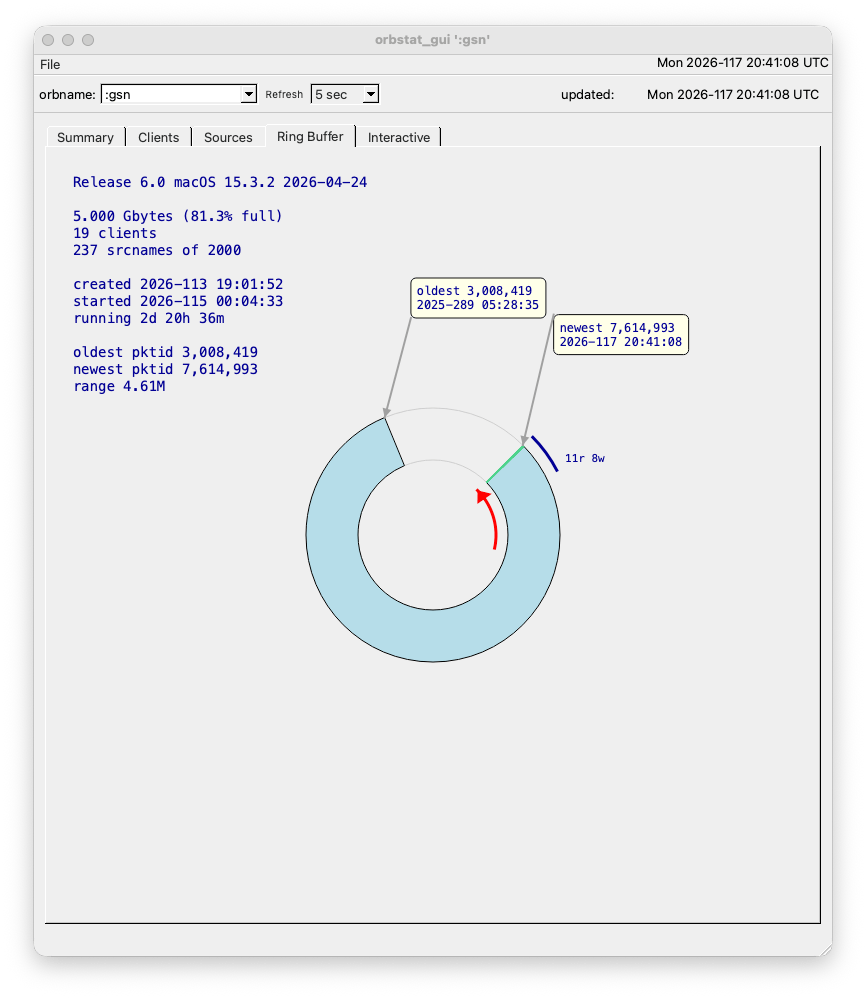
orbstat_gui adds a new ring-buffer visualization panel, client lag indicators, DNS failure display, match/reject source filters, and an interactive panel for inspecting individual packets and sending Orb commands.
dbe
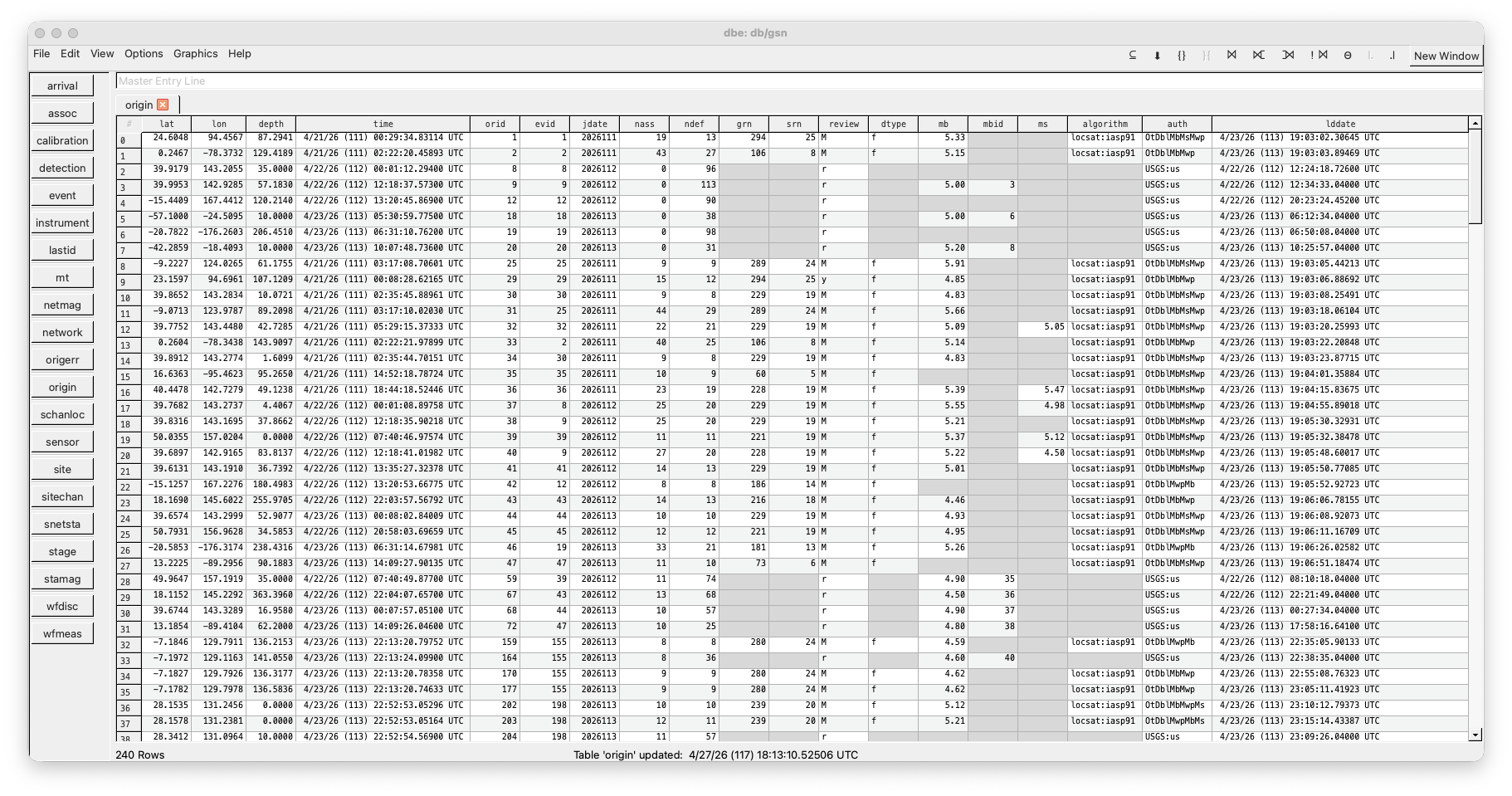
dbe gets a more modern layout, the ability to add columns based on database expressions, an ungroup capability, and a restructured row viewer with better cell selection and editing. Hypocenter and station maps can now be created and displayed directly in the dbe program window.
COSMOS V0 for Strong-Motion Networks
For the strong-motion community, Antelope 6.0 introduces a complete tooling suite for the COSMOS V0 data format: orb2v0 for real-time export, v02db for database ingestion, v0verify for validation, and inspect_v0 for inspection. These programs leverage new schema tables for V0-specific metadata (v0scnl, v0dataless, v0sensor, v0datalogger, and v0nets) and integrate directly with dbe.
Cloud-Ready Containers
To support cluster computing and cloud deployments, lightweight Docker container images are now available for key Antelope programs, including orb2orb, orb2seedlink, seedlink2orb, q82orb, orb2dbt, orb2wf, orbassoc, orbdetect, orbevproc, orbstat, orb2ws, and orbserver. Contact info@brtt.com for additional information.
Platform and Toolchain
Antelope 6.0 runs on 64-bit x86 RedHat 9 Linux, Ubuntu 22 Linux, and macOS M-series 15 or 26 (Sequoia or Tahoe). Linux remains our recommended choice for enterprise-class monitoring. Qt 6.10.1 is supported on all primary platforms. New toolchain build scripts are included for RHEL9 gcc 12.2.0, RHEL8 and RHEL9 clang 15, along with improved integration with macOS native toolchains.
Notable Bug Fixes
- Multiple fixes that address memory and CPU usage often encountered on large networks.
- Lock-up prevention fixes added to core and GUI programs.
- orbassoc, dbgrassoc, and orbevassoc prevent duplicate events when multiple origin-only solutions arrive by adding proximity matching in the smart associator.
- Multiple edge case segfault bugs in core libraries affecting multiple programs.
Get Antelope 6.0
Antelope 6.0 is available now. Existing license holders will receive download instructions via email, and full installation, license, and demo instructions are included in the README at the root of the ISO image. Customers without keys for this release can obtain them by submitting the registration form during installation.
Support for releases prior to and including Antelope 6.0 has shifted to this new release. All future maintenance and support requests should be relative to Antelope 6.0.
The complete change list is summarized in the Changes file in the ISO image root directory and at brtt.com/software/latest-release. For questions, email info@brtt.com or visit brtt.com. Current customers can request support by emailing support@brtt.com.